
Freija
Forum Wench
- Joined
- May 20, 2026
- Messages
- 429
- Reaction score
- 835
@-- TPTB -- edit
Duplicate topic - posts moved from newer thread to this previous one. Freija can't seem to remember what she does one day to the next. Sorry for the confusion.
I should have put this in natural and man-made disasters. What else could it be? This sounds like such a bad idea. What's next? Frikkin' laser beams?

 gizmodo.com
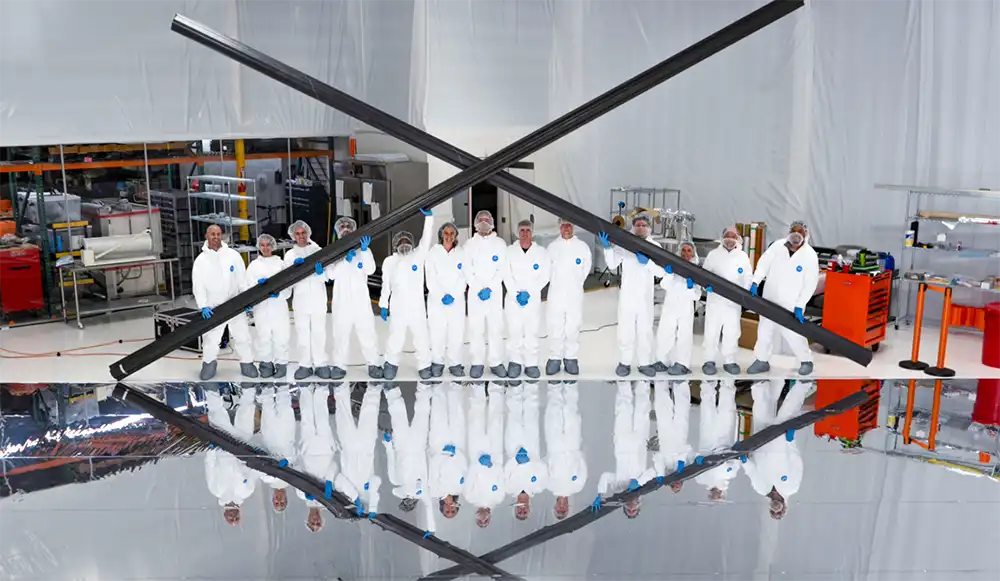
The Federal Communications Commission (FCC) granted approval for the launch of Reflect Orbital’s prototype satellite, which will test the ability to reflect sunlight down to Earth after dark. The satellite is set to launch to low Earth orbit later this year, where it is designed to deploy a 59-foot (18-meter) film reflector.
If proven successful, Reflect Orbital has plans to deploy up to 50,000 in-space mirrors mounted on satellites to create sunlight after dark. Its proposed constellation raises concerns over disrupting astronomers’ views of the cosmos.
Let's face, we're doomed.
Duplicate topic - posts moved from newer thread to this previous one. Freija can't seem to remember what she does one day to the next. Sorry for the confusion.
I should have put this in natural and man-made disasters. What else could it be? This sounds like such a bad idea. What's next? Frikkin' laser beams?
This Startup Wants to Use Space Mirrors to Light Up Earth at Night. Feds Just Said Go Ahead
The startup will begin testing its idea of creating sunlight after dark.
gizmodo.com
The Feds Just Said Go Ahead
California startup Reflect Orbital received clearance to launch its first satellite, aiming to build a constellation to illuminate dark areas with in-space mirrors.The Federal Communications Commission (FCC) granted approval for the launch of Reflect Orbital’s prototype satellite, which will test the ability to reflect sunlight down to Earth after dark. The satellite is set to launch to low Earth orbit later this year, where it is designed to deploy a 59-foot (18-meter) film reflector.
If proven successful, Reflect Orbital has plans to deploy up to 50,000 in-space mirrors mounted on satellites to create sunlight after dark. Its proposed constellation raises concerns over disrupting astronomers’ views of the cosmos.
Sunlight after dark
The California-based startup applied to launch a 59-foot-long (18-meter-long) prototype satellite named Earendil-1 to test its idea: bouncing sunlight off a mirror and reflecting it onto a designated area.
Through its proposed constellation, Reflect Orbital envisions being able to illuminate areas up to 3 miles (5 kilometers) at a time with intensities ranging between 0.8 and 2.3 lux. By comparison, a full Moon provides an illumination of around 0.05 to 0.3 lux on a clear night.
Why, you might ask? Well, the company wants to use its technology to illuminate disaster zones and search-and-rescue missions, extend working hours for industrial sites, boost agricultural yields and extend cycles, reduce light pollution by replacing city lights, and provide light for defense operations, according to Reflect Orbital’s website.
Orbital disruption
Ahead of the launch of its first satellite, Reflect Orbital’s proposed constellation has already drawn criticism from astronomers who fear the in-space mirrors will impact their ability to capture the night skies.
The European Southern Observatory (ESO) released a recent report that measured the extent to which bright constellations, such as the one proposed by Reflect Orbital, would affect ground-based observations. The report found that the full fleet of Reflect Orbital’s satellites, when illuminated by the Sun, would lead to the loss of every image from a camera like that of the Rubin Observatory.
DarkSky International also issued a statement in response to the proposed constellation, advocating for “transparency, environmental review, and public accountability before any such systems are approved or deployed.”
Reflect Orbital stated that the company is a member of the International Astronomical Union’s Centre for the Protection of the Dark and Quiet Sky and works closely with astronomers to mitigate the effects of its satellites. The company claims that it will “systematically avoid redirecting light near observatories,” Reflect Orbital wrote in an emailed statement.
“Our satellites’ default will be “off” and we will retain full control to turn them off, dim the light and relocate the spot at any stage,” the company wrote. “Every spot of light we deliver will be requested, approved and contained. We will only provide redirected sunlight when it is signed off by the appropriate authorities in the relevant jurisdiction.”
In response to Reflect Orbital’s application, the FCC stated that concerns over the impact of Eärendil-1 on astronomy were out of its jurisdiction and “are not a basis for denial of or additional conditions on Reflect Orbital’s operations.”
Let's face, we're doomed.
Last edited by a moderator: